
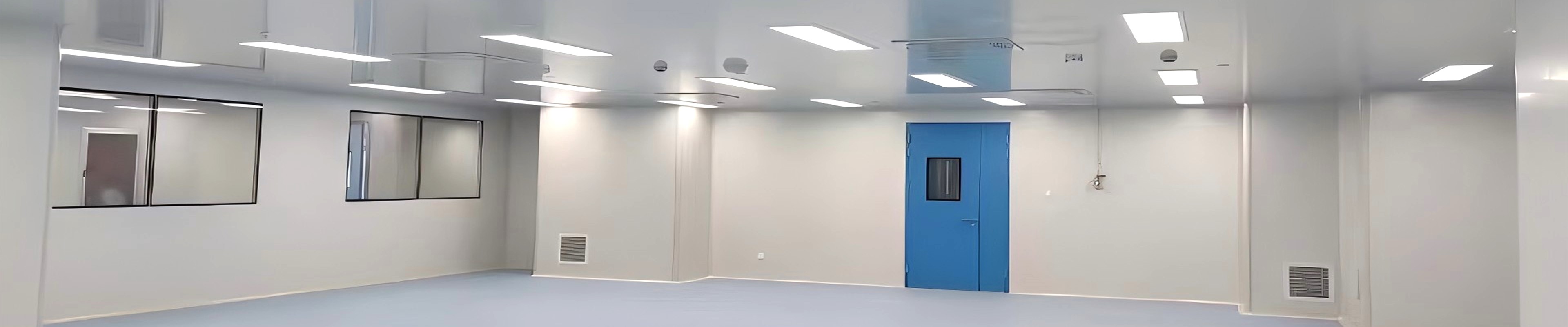
Cleanroom HVAC automatic control systems automatically regulate indoor air temperature, relative humidity, and cleanliness levels to maintain the conditions required by the controlled environment. By ensuring that temperature, humidity, and air purity meet the specified standards of each classified zone, these systems safeguard both product quality and the health and safety of personnel working within the facility.
An effective automatic control system is not merely a convenience — it is an integral part of the cleanroom infrastructure. Without reliable automatic regulation, temperature drift, humidity fluctuations, and pressure losses can compromise the validated state of the cleanroom, putting products, processes, and personnel at risk. Understanding the available control system architectures and their appropriate applications is a foundational competency for cleanroom operators, facility managers, and MEP engineers.
1. Classification of Cleanroom HVAC Automatic Control Systems
In the context of central air-conditioning control, the most commonly used control system architectures can be grouped into four categories, ranging from basic relay-based start/stop logic to advanced distributed microprocessor networks. Each level represents a step increase in complexity, capability, and — critically — the degree to which the system can maintain the controlled environment automatically, without continuous human intervention.
1.1 Equipment Centralized Start/Stop Control System
This system uses switches, contactors, and relays to enable the remote start and stop of air-conditioning equipment, with indicator lights displaying the current operating status of each unit.
Strictly speaking, this architecture cannot be classified as a true control system: it lacks a closed feedback loop and provides no automatic correction. Operators can only infer equipment status from on-site instrumentation. When a fault occurs — or when temperature, humidity, or differential pressure falls outside the specified range — the system requires manual intervention. There is no automatic response to deviations, and no data logging for trend analysis or regulatory review.
This type of system is typically found in low-specification facilities or as a supplementary manual override layer within more advanced architectures. It is not suitable as the primary control mechanism for any regulated cleanroom application.
1.2 Analog Instrument Automatic Control System
The analog system represents the first true closed-loop architecture. Its operating principle is as follows:
1. Data acquisition: on-site sensors collect process data — temperature, humidity, pressure — and transmit it to the controller.
2. Comparison: the controller compares the measured values against pre-set parameters.
3. Correction: if a deviation is detected, the controller sends a signal to the actuator, which adjusts the relevant valve or damper to bring the parameter back within the specified range.
This architecture is capable of continuous automatic regulation and is significantly more reliable than the start/stop approach for maintaining steady-state conditions. However, its flexibility is limited: the control algorithms are typically fixed-function, and expanding the system to cover additional parameters or zones requires additional hardware loops. Analog systems remain in service in older facilities but have largely been superseded by digital architectures in new installations.
1.3 Direct Digital Control (DDC) System
A Direct Digital Control system uses a DDC controller — a dedicated microprocessor-based unit — along with field hardware including sensors, actuators, and an operating control software package, to manage multiple air-handling units automatically.
A fully featured DDC system provides the following capabilities:
• Start/stop control of air-handling units
• Real-time display of operating status
• Manual and automatic mode status indication
• Fault alarm management
• Variable frequency drive (VFD) control for fan speed modulation
• Duct filter blockage alarm based on differential pressure monitoring
• Cooling and heating coil valve position control and status display
• Humidification control
• Electric reheater control
• Return air damper control
The key advantage of DDC over analog systems is software flexibility: the control algorithms, setpoints, alarm limits, and alarm priorities can all be modified through the operator interface without hardware changes. This makes DDC the standard architecture for cleanroom HVAC control in new construction and major retrofits.
1.4 Distributed Control System (DCS)
A Distributed Control System is a microprocessor-based integrated control architecture that merges computing, instrumentation, and electrical control technology within a single coordinated platform. When combined with appropriate software, a DCS delivers:
• Automatic data acquisition and processing
• Process graphic display
• Parameter exceedance alarms
• Equipment fault alarms
• Report printing and historical data archiving
A DCS continuously monitors the operating status of fans, filters, and other critical equipment, collecting temperature, humidity, pressure, and other relevant parameters to build historical trend records that can be reviewed at any time. User access control with defined security levels further supports both operational convenience and system safety.
In cleanroom applications, the DCS architecture is particularly valuable for its ability to integrate HVAC, electrical, and auxiliary systems under a single monitoring and management platform — reducing the number of separate operator interfaces and enabling coordinated responses to alarms across systems.
2. Working Condition Automatic Conversion
Cleanroom HVAC systems operate according to defined working conditions. An effective automatic control system must therefore include working condition (mode) conversion capability — the ability to switch the system between pre-defined operating modes automatically based on ambient or load conditions.
2.1 Basic Mode Conversion
Summer mode: the cooling coil is active, controlling the chilled water flow rate to regulate indoor temperature. Winter mode: the system switches to the heating coil, controlling the hot water or steam flow to maintain the set temperature. This fundamental seasonal switchover — from cooling to heating — is the most basic form of mode conversion.
2.2 Energy-Saving Mode Conversion
For year-round operating cleanrooms, mode conversion processing is essential to achieving energy efficiency. The goal is to avoid simultaneous cooling and heating— a condition where the cooling coil and heating coil are both active at the same time, wasting energy — and to make optimal use of outdoor air (fresh air), return air, and the full capacity of the air-handling equipment.
Beyond basic temperature and humidity regulation, an effective automatic control strategy must coordinate the mode conversion logic with the following operational parameters:
• Outdoor air temperature and enthalpy for free cooling assessment
• Return air conditions to optimise mixed-air ratio
• Occupancy schedules to adjust ventilation rates
• Process load profiles to anticipate demand peaks
Advanced DDC and DCS platforms are capable of implementing these multi-variable optimisation strategies automatically, reducing energy consumption while maintaining the specified environmental conditions within the cleanroom at all times.
3. Development Trends in Cleanroom HVAC Automatic Control
3.1 Environmental Protection and Energy Efficiency
Rising expectations for cleanroom environments are driving continuous improvement in cleanroom HVAC management standards, which in turn accelerates the development of more sophisticated automatic control systems. The primary purpose of any cleanroom HVAC installation is to maintain the required cleanliness, temperature, and humidity — but in the context of increasing energy scarcity and stricter environmental regulations, HVAC systems must also contribute to energy efficiency and sustainability goals.
HVAC systems represent a significant proportion of total hospital and facility energy consumption. Addressing this, the diversification of energy sources — including solar thermal and geothermal energy applications — provides new foundations for reducing the carbon footprint of air-conditioning systems. The critical question becomes: how can these renewable and compound energy sources be integrated into and optimised within the HVAC system, and how does the automatic control system enable that optimisation?
Key technical challenges that automatic control systems must address include:
• Optimisation of renewable and compound energy source utilisation
• Energy recovery from exhaust air streams
• Improvement of fan and pump efficiency through variable speed control
• Integration of thermal energy storage for peak-load shifting
Solving these challenges will unlock significant expansion of the HVAC automatic control market, particularly as hospital and facility decarbonisation targets become more stringent.
3.2 Centralized Control and System Integration
A fundamental question in the evolution of cleanroom HVAC control is the choice between large-scale systems — such as a Building Management System (BMS) or Building Automation System (BAS) — and smaller, dedicated control units (mechatronic units). Both approaches offer distinct advantages:
| System Type | Key Advantages | Typical Application |
| Large-scale system (BMS/BAS) | Broad compatibility and strong management capability; powerful system-wide optimisation functions; single interface for HVAC, electrical, lighting, and fire safety. | Preferred for large hospital and multi-zone pharmaceutical facilities |
| Small dedicated system (mechatronic) | High specificity to the air-handling unit; flexible and fast-responding; simpler to configure for single-zone or single-unit applications. | Preferred for compact cleanrooms and modular facilities |
| Distributed Control System (DCS) | Combines the integration benefits of large systems with the specificity of dedicated units; scalable from single-unit to facility-wide deployments; supports hierarchical management and remote monitoring. | The emerging standard for new cleanroom HVAC projects |
3.3 The Broader Value of Cleanroom HVAC Automation
As scientific knowledge and manufacturing standards advance, the requirements for indoor air temperature, humidity, airflow velocity, and cleanliness continue to become more demanding. Simultaneously, environmental protection and energy conservation are receiving increasing institutional attention. Developing cleanroom HVAC automatic control capability delivers measurable benefits across multiple dimensions:
• Energy savings for hospitals and manufacturing facilities
• Improved patient safety and product quality through tighter environmental control
• Higher overall facility management efficiency
• Faster and more coordinated emergency response capability
By deepening understanding of HVAC automatic control systems and integrating the world's leading control technologies into domestic practice, the cleanroom air-conditioning industry in the hospital and pharmaceutical sectors can achieve sustained, substantial progress.
Contact SCT Cleanroom
Website: www.sctcleanroom.com
Email: admin@sctcleanroom.com
WhatsApp: +86 15306200553
Post time: Sep-24-2026