
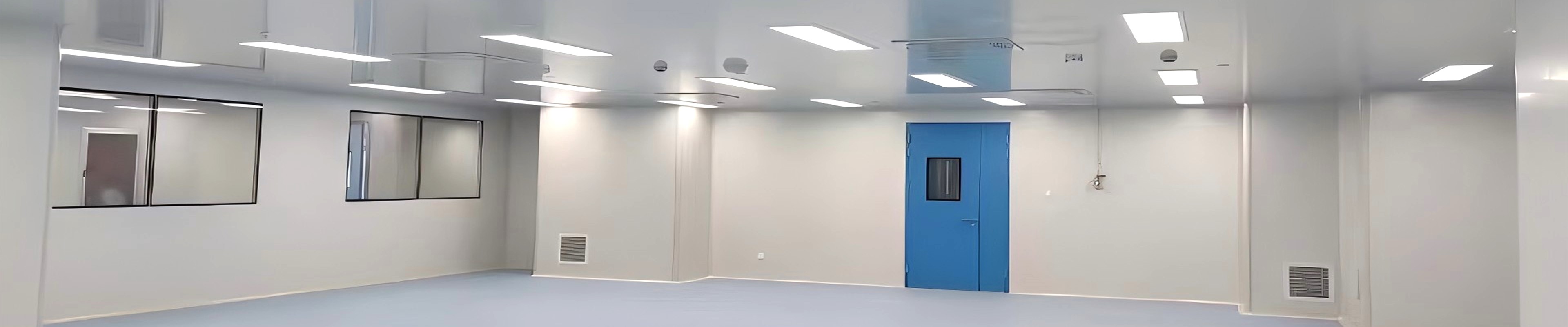
In the electronics manufacturing industry, the demand for precision and reliability continues to rise. From microprocessors and sensors to display panels and printed circuit boards, every electronic component must be produced in a tightly controlled environment. That environment is the cleanroom—and its role extends far beyond semiconductor fabrication, supporting the entire electronics manufacturing value chain.
By controlling airborne particles, temperature, humidity, and pressure, cleanrooms create a contamination-free production space that prevents external pollutants from interfering with highly sensitive manufacturing processes.
The Foundation and Lifeline of a Cleanroom Environment

1.The Science and Art of Particle Control
Particle control is the core of cleanroom design. Microscopic airborne particles, invisible to the naked eye, can be fatal to precision electronic components. In a seemingly clean conventional environment, the air may contain millions of particles per cubic meter. In contrast, the highest-grade cleanrooms allow no more than 10 particles larger than 0.5 microns per cubic meter.
To achieve this level of cleanliness, cleanrooms rely on multi-stage filtration systems. High-Efficiency Particulate Air (HEPA) filters and Ultra-Low Penetration Air (ULPA) filters play a critical role, capturing more than 99.99% of particles as small as 0.3 microns or even smaller.
However, cleanroom design goes far beyond installing filters. It requires a complete airflow management strategy, including:
➤Laminar airflow systems, where air moves in parallel streams at uniform velocity, creating an “air piston” effect that pushes contaminants out of the workspace.
➤Turbulent airflow systems, which dilute contaminants by continuously mixing and filtering the air.
➤Air showers, where personnel are exposed to high-velocity clean air before entering controlled areas.
➤Airlocks, which serve as buffer zones between areas of different cleanliness levels to maintain stable pressure differentials.
2.Precision Temperature and Humidity Control
In addition to particle control, stable temperature and humidity are critical in electronics manufacturing. Semiconductor materials are extremely sensitive to temperature fluctuations, and modern lithography tools require temperature stability within ±0.1°C to maintain nanometer-level alignment accuracy.
Humidity control is equally important. Excessive humidity can cause metal corrosion and material degradation, while overly dry air increases the risk of electrostatic discharge (ESD), potentially damaging sensitive electronic devices. In most electronics cleanrooms, relative humidity is typically maintained between 30% and 50%, with precise adjustments based on specific process requirements.
Cleanroom Protection Throughout the Electronics Manufacturing Process

How Cleanrooms Support Every Stage of Production
From raw silicon wafers to finished products, different stages of electronics manufacturing demand specific cleanroom conditions.
Wafer fabrication is the most demanding stage. Even the smallest particle can cause circuit shorts or open circuits, leading to device failure. As semiconductor processes evolve from micron-scale to nanometer-scale nodes, cleanliness requirements become increasingly stringent. At 5 nm and more advanced technology nodes, particles much smaller than the critical dimension must be controlled, as they can cluster and form larger contamination defects.
Packaging and testing processes require slightly lower cleanliness levels than front-end wafer fabrication but still typically operate at Class 1,000 or better. Particulate contamination at this stage can lead to poor wire bonding, package defects, and reduced product reliability and lifespan.
In PCB manufacturing, cleanroom environments ensure accurate formation of fine circuit traces and prevent defects during exposure, etching, and electroplating. For high-density interconnect (HDI) boards with micron-scale line widths and spacing, even minimal contamination can result in short circuits or open connections.
Display panel manufacturing also depends heavily on cleanroom technology. In OLED and Micro LED production, dust particles can cause pixel defects, resulting in bright spots or dark spots. Large-area panel production presents unique challenges, as it requires uniform temperature and humidity control across expansive spaces while maintaining strict cleanliness standards.
Controlling Materials and Personnel
Cleanroom contamination control extends beyond the air to everything that enters the environment, including materials and personnel. Raw materials, equipment, and tools can all introduce contaminants. As a result, cleanrooms implement strict material handling procedures, such as packaging removal, cleaning, and controlled transfer processes.
Personnel are the largest source of contamination in any cleanroom. A single person can shed approximately 100,000 skin particles per minute while standing still, and millions more while moving. Effective cleanroom management therefore includes:
➤Specialized training to ensure personnel understand and follow cleanroom protocols.
➤Full cleanroom garments, including hoods, masks, coveralls, gloves, and dedicated footwear.
➤Strict access procedures, such as air showers and staged entry zones.
➤Behavioral controls, limiting unnecessary movement and conversation inside the cleanroom.
Energy Efficiency and Sustainable Cleanroom Design
Traditional cleanrooms are highly energy-intensive, consuming 10 to 50 times more energy than standard office buildings. Most of this energy is used for air circulation, temperature and humidity control, and pressure maintenance. Modern cleanroom design increasingly prioritizes energy efficiency and sustainability through measures such as:
➤Zoned layouts, aligning cleanliness levels with actual process requirements to avoid overdesign.
➤Variable air volume (VAV) systems, adjusting airflow based on real-time demand.
➤Heat recovery systems, reclaiming energy from exhaust air to precondition incoming fresh air.
➤High-efficiency motors and variable frequency drives (VFDs) to improve system performance.
➤Real-time monitoring and optimization, using sensor networks and data analytics to fine-tune operations.
The Future of Cleanroom Technology in Electronics Manufacturing

As electronic technologies move toward higher precision and smaller feature sizes, cleanroom technology continues to evolve. Key development trends include:
➤Molecular contamination control, shifting focus from particles to airborne molecular contaminants.
➤Nano-level electrostatic protection, addressing the growing sensitivity of advanced electronic devices.
➤Smart operation and maintenance, leveraging IoT and AI for predictive maintenance.
➤Modular and flexible cleanroom designs, enabling rapid adaptation to changing production needs.
➤Green cleanrooms, fully integrating sustainability principles into design and operation.
From smartphones and automotive electronics to medical devices and industrial control systems, virtually every modern electronic product benefits from cleanroom technology. Cleanrooms are no longer exclusive to chip manufacturing—they are a fundamental safeguard across the entire electronics manufacturing ecosystem.
More than just a physical space, a cleanroom represents a comprehensive contamination control philosophy that integrates people, materials, equipment, and the environment into a single coordinated system. As electronics continue to advance, cleanroom technology will evolve alongside them, providing cleaner, more stable, and more reliable manufacturing environments. In this sense, cleanrooms are not only the guardians of electronics manufacturing—but also powerful enablers of future innovation.
Post time: Jan-05-2026