
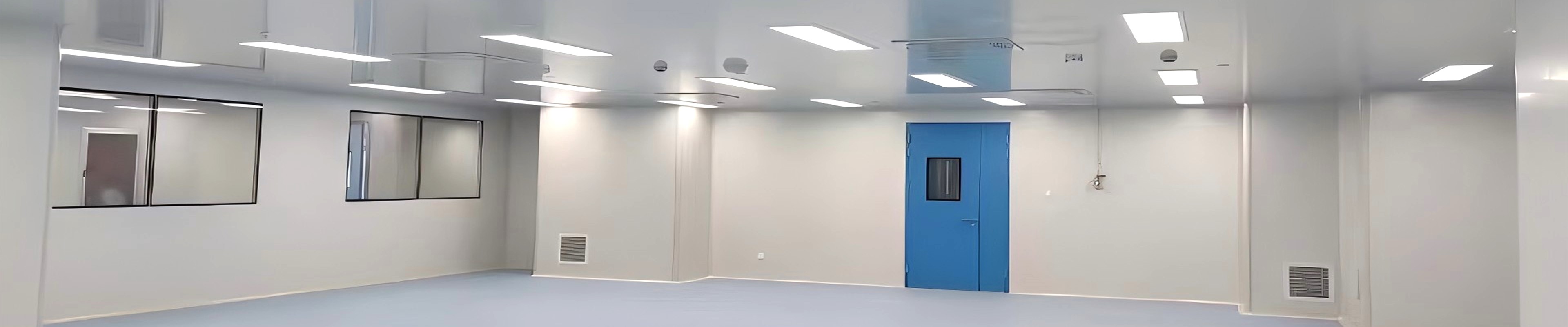
Maintaining positive pressure in a cleanroom is a widely understood principle. But the reasoning behind it — how much differential pressure to specify, what happens when conditions require the opposite, and why the gradient matters more than any single reading — is frequently misunderstood even among engineers with years of field experience.
This article resolves the most common points of confusion: the physical rationale for positive pressure, the numerical requirements of GB 50073, the specific applications that demand negative pressure, and the practical field methods for verifying that the pressure regime is working correctly.
1. Key Takeaways at a Glance
Cleanrooms maintain positive pressure so that air flows from cleaner zones toward less clean zones. This directional airflow is what prevents external contaminants from entering the controlled space. The pressure differential is set according to GB 50073:
| Application | Minimum Differential Pressure | Note |
| Between adjacent cleanroom classes | ≥ 5 Pa | Minimum to ensure directional airflow |
| Clean zone vs. non-clean zone | ≥ 5 Pa | Standard requirement; GMP projects commonly apply 10 Pa |
| Clean zone vs. outdoors | ≥ 10 Pa | Higher threshold to resist wind pressure and door-opening effects |
Positive pressure protects the room itself. Negative pressure — where the room pressure is lower than the surrounding environment — is used when the process inside generates hazardous or unwanted substances that must not escape: toxic vapours, pathogenic organisms, dust, or radioactive materials. The governing principle is simple: use positive pressure to protect the cleanroom; use negative pressure to protect everything outside it.
2. Why Positive Pressure Is the Default
Positive pressure means the indoor air pressure is higher than the pressure outside the room. Air naturally moves from high pressure to low pressure — it flows outward through every gap: door seams, observation windows, pipe penetrations, pass box openings, and light fixture seals. The greater the indoor pressure, the more forcefully air escapes through these pathways. Contaminants in the surrounding environment — road dust, industrial particulate, pollen — are physically blocked from entering. It is like inflating a room: the more air you pump in, the harder the air pushes outward, and the harder it is for anything to get in.
2.1 Three Functions of Positive Pressure
• Blocking external contaminants: outdoor and corridor air contains dust, microbes, and particulate that will degrade cleanroom cleanliness if allowed to infiltrate
• Preventing cross-contamination between cleanroom classes: adjacent zones of different ISO classes must not mix; pressure differentials ensure each zone receives air from the cleaner side
• Stabilising cleanliness levels over time: cleanroom cleanliness is maintained by two factors — HEPA filtration of supply air and pressure differentials that prevent ingress; without pressure control, even a properly filtered supply will see rapid recontamination
2.2 Field Verification Without Instrumentation
When a differential pressure gauge is not available, a simple smoke test provides a quick qualitative check. Hold an incense stick or smoke tube near the door seam:
• Smoke flows outward (away from the room): positive pressure — the room is properly pressurised
• Smoke flows inward (into the room): negative pressure or the pressure differential has collapsed
2.3 A Critical Point: Pressure Is Not Set — It Escapes
A commonly held misconception is that pressure is a directly set parameter. In fact, the differential pressure is the result of air escaping through the building envelope. The supply air that enters the room must also leave — through door gaps, pipe penetrations, pass boxes, light fixtures, and any other penetrations. The more leakage points exist, the more supply air must be provided to maintain the same pressure. This means the seal integrity of the building envelope is the foundation on which all pressure control rests.
Per GB 50073 Section 6.2.4, the start-up sequence for a positive-pressure cleanroom is: start the supply fan first, then start the return and exhaust fans. The shutdown sequence is reversed. If this sequence is reversed during start-up or shutdown, the brief moment when both supply and exhaust are off or partially active allows reverse airflow — the door seams will actively draw air inward during those critical seconds.
3. How Much Differential Pressure Is Appropriate
The governing principle is a pressure gradient: cleaner zones have higher pressure, less clean zones have lower pressure, stepping down level by level from the most controlled space to the least controlled.
A typical gradient for a GMP pharmaceutical facility:
| Zone | Typical Pressure (relative) | Role in Gradient |
| ISO Class 5 (Grade A/B) | +15 Pa | Primary controlled environment — highest pressure |
| ISO Class 7 (Grade C/D) | +10 Pa | Secondary clean zones |
| ISO Class 8 (Grade E) | +5 Pa | Tertiary support areas |
| Corridor / Changing Room | 0 Pa (reference) | Transition zone — neutral pressure |
| Exterior / Outdoors | –10 Pa relative to clean zone | Ambient — lowest pressure |
3.1 GB 50073 Numerical Requirements
GB 50073 specifies the following minimum differentials:
• Adjacent cleanroom classes: not less than 5 Pa
• Clean zone vs. non-clean zone: not less than 5 Pa (10 Pa in GMP projects)
• Clean zone vs. outdoors: not less than 10 Pa
3.2 Why the Outdoor Threshold Is Double
The 10 Pa minimum for clean zone vs. outdoors exists because outdoor environments are subject to wind pressure. When wind blows against a building facade, it can impose a positive pressure on the external envelope. A door opening in a wall that is simultaneously experiencing wind pressure can drive outdoor air inward with significant force. Ten pascals provides a buffer against this effect; five pascals does not.
Five pascals is the minimum to establish directional airflow. Below five pascals, normal activities — a person walking through a door, a fan motor cycling, a door opening in an adjacent corridor — can overcome the pressure barrier entirely, temporarily or permanently breaching the gradient.
3.3 A Practical Conversion for Field Use
One pascal is approximately equal to 0.1 millimetres water column (mmH₂O). This conversion is useful when reading older manometer-style differential pressure gauges, which were often calibrated in millimetres water column:
| Differential Pressure | Equivalent (mmH₂O) | Application |
| 5 Pa | ≈ 0.5 mmH₂O | GB 50073 minimum between clean classes |
| 10 Pa | ≈ 1.0 mmH₂O | Standard for clean zone vs. outdoors; GMP projects for clean vs. non-clean |
| 15 Pa | ≈ 1.5 mmH₂O | Common specification for ISO Class 5 zones |
3.4 Upper Limit: More Is Not Always Better
There is a common misconception that pressure differentials should be maximised. In practice, excessive pressure differentials cause:
• Difficult door operation: high-pressure rooms require significant force to open doors, creating safety hazards and user frustration
• Increased energy consumption: higher pressure differentials require greater supply air volumes, increasing fan energy and HVAC operating costs
• Excessive air leakage through seals: door seam gaskets, window seals, and penetration seals experience greater stress and shorter service lives
• Noise: high-velocity air escaping through small gaps generates audible noise, particularly noticeable at door seams
The correct approach is to apply the minimum pressure differential that ensures directional airflow across the full range of operational conditions — not to treat pressure as a performance metric to be maximised.
3.5 Measuring the Gradient Correctly
Differential pressure must be measured as a gradient — one zone relative to the next — not as an absolute reading for each room in isolation. The correct procedure is to measure from the innermost cleanest room outward, confirming that each step in the gradient is maintained. A reading of 1–2 Pa between adjacent zones is effectively no differential pressure — below the GB 50073 minimum — and would constitute a non-conformance finding during a regulatory audit.
4. When Negative Pressure Is Required
Some rooms have the opposite requirement: the substances generated inside — pathogens, spores, dust, toxic gases, or radioactive materials — must not be allowed to escape into the surrounding environment. In these cases, the room pressure is set lower than the surrounding space. Air flows inward from outside, and the contaminants are held within. The principle is straightforward: negative pressure protects the environment outside the room.
4.1 Common Negative Pressure Applications
| Application | Rationale for Negative Pressure |
| Biosafety laboratories (BSL-2, BSL-3, BSL-4) | Pathogens and infectious aerosols are handled inside; negative pressure prevents escape to corridors and common areas; BSL-3 and BSL-4 have stringent negative pressure requirements that increase with biosafety level |
| Negative pressure isolation rooms | Used for patients with airborne infectious diseases (e.g., SARS, Ebola haemorrhagic fever); room-to-corridor negative pressure ensures pathogens cannot exit the room in any airflow |
| Dust collection and grinding rooms | Abrasive and metallic dust generated during machining and polishing must be contained within the room and captured by local exhaust ventilation; negative pressure at the room boundary prevents dust migration to adjacent areas |
| Toxic chemical handling rooms | Solvent vapours, reagent fumes, and painting operations generate toxic or flammable vapours that must be exhausted and treated before release; negative pressure prevents vapour migration to other facility areas |
| Radioactive materials rooms | Radioactive contamination must be contained; exhaust air is filtered and discharged via a monitored stack; room negative pressure ensures no uncontrolled release occurs |
4.2 How Negative Pressure Is Generated
Negative pressure is created when exhaust airflow exceeds supply airflow. If a room receives less air than it loses through exhaust and leakage, the indoor pressure drops below that of adjoining spaces; external air is drawn inward to make up the deficit, and the directional airflow is reversed.
Biosafety laboratories implement a layered approach: the clean side of the facility maintains positive pressure, the contaminated side maintains negative pressure, and a series of airlocked buffer rooms separates the two. Personnel entering a contaminated zone pass through each buffer room in sequence, with each successive room at a lower pressure — pressure steps down from clean to contaminated, not the reverse. This gradient prevents any breach in the pressure boundary from allowing contaminants to travel back toward the clean side.
4.3 Field Recognition of Negative Pressure
A correctly operating negative pressure room can be identified by:
• Air flowing inward at door seams: held near the door gap, smoke or incense smoke is drawn into the room
• Resistance when opening the door: the inward airflow creates a slight resistance to opening, opposite to the push felt entering a positive-pressure room
• If no resistance is felt when opening a negative pressure room door, the exhaust system may have stopped or the ductwork may be blocked — this is an immediate safety concern requiring investigation
5. Positive vs. Negative Pressure: Side-by-Side Comparison
| Parameter | Positive Pressure | Negative Pressure |
| Pressure relationship | Indoor pressure > outdoor pressure | Indoor pressure < outdoor pressure |
| Airflow direction | From inside to outside (outward leakage) | From outside to inside (inward leakage) |
| Purpose | Protect the cleanroom environment from external contamination | Protect the external environment from room contents |
| Typical applications | Pharmaceutical cleanrooms, operating theatres, electronics assembly | Biosafety laboratories, isolation rooms, dust grinding rooms, toxic chemical rooms |
| Differential pressure | Adjacent classes ≥5 Pa; vs. outdoors ≥10 Pa | Generally ≥5 Pa; specific values set by process requirements |
| Air volume relationship | Supply airflow > exhaust airflow | Exhaust airflow > supply airflow |
| Door sensation | Push outward to open; slight resistance entering | Pull inward to open; slight resistance exiting |
| GB 50073 reference | Sections 6.2.1–6.2.4 | Process-specific requirements; biosafety standards (WHO BSL classifications) |
6. Common Misconceptions
6.1 "All cleanrooms must have positive pressure."
False. Many cleanrooms contain processes that generate hazardous materials — pathogenic organisms, toxic dust, flammable vapours — and these require negative pressure to protect the surrounding environment. A GMP pharmaceutical facility typically has both: positive-pressure clean zones for aseptic production, and negative-pressure zones for toxic drug handling, sample storage, and potency testing rooms.
6.2 "A larger differential pressure is always better."
False. GB 50073 specifies minimum values — "not less than" — not targets to be exceeded. Excessive differentials increase energy consumption, cause door operational difficulties, accelerate seal wear, and generate noise. The correct approach is to meet the minimum requirement across all operational conditions.
6.3 "Checking one room's pressure is sufficient."
False. Pressure is a gradient. The intermediate zones — change rooms, buffer rooms, transition corridors — must sit between the pressures of the zones they connect. The most commonly missed failure in pressure verification is a missing intermediate step in the gradient. If any step in the gradient collapses, air will find an alternate pathway — through unsealed penetrations, ceilings, or service shafts — and bypass the intended pressure boundary.
6.4 "Negative pressure rooms do not need to meet cleanliness standards."
False. Negative pressure determines airflow direction, not cleanliness. A biosafety Level 3 laboratory must simultaneously achieve a specified negative pressure AND the required cleanroom class for the work being performed. Pressure and cleanliness are independent parameters; each must meet its own requirement.
Conclusion
The choice between positive and negative pressure is governed by a single question: what must be protected? Positive pressure keeps the external environment out of the cleanroom; negative pressure keeps the room's hazardous contents from escaping. The practical rules that follow from this principle are:
• Positive pressure rooms: maintain ≥5 Pa between clean classes, ≥10 Pa against outdoors; apply minimum necessary — not maximum achievable — differential
• Negative pressure rooms: differential is set by process hazard assessment; BSL-2 laboratories typically target approximately –10 Pa relative to corridors, with BSL-3 and BSL-4 at more negative values
• The gradient must be continuous: every step between the cleanest zone and the least-controlled zone must be accounted for, including buffer rooms and transition corridors
• Envelope integrity is the foundation: pressure cannot be controlled if the building structure leaks unpredictably; seal quality determines whether the designed pressure is actually achieved
Understanding why the pressure direction matters — not just which direction it should be — is what enables engineers and facility managers to diagnose problems, specify equipment correctly, and commission systems with confidence.
Frequently Asked Questions
Q1: What is the minimum differential pressure between adjacent cleanroom classes according to GB 50073?
GB 50073 specifies a minimum of 5 Pa between adjacent cleanroom classes. For clean zones versus non-clean zones, the minimum is also 5 Pa (with GMP projects commonly applying 10 Pa as a design target). For clean zones versus outdoors, the minimum is 10 Pa, to account for wind pressure effects on building facades and door openings.
────────────────────────────────────────────────────────────────────────────────
Q2: Is positive pressure required in all cleanrooms?
No. Positive pressure is the default for cleanrooms where the primary concern is keeping external contaminants out. However, rooms that handle toxic, pathogenic, dusty, or radioactive materials require negative pressure — to prevent their contents from escaping into adjacent areas. A GMP pharmaceutical facility typically uses both: positive pressure in aseptic manufacturing zones, and negative pressure in toxic drug handling or sample storage rooms.
────────────────────────────────────────────────────────────────────────────────
Q3: Why is the pressure differential against outdoors set at 10 Pa rather than 5 Pa?
Outdoor environments are subject to wind pressure, which can impose significant positive force on building surfaces during windy conditions. When a door opens in a wall simultaneously experiencing wind loading, outdoor air can be driven inward with enough force to overcome a 5 Pa barrier. Ten pascals provides a sufficient buffer against this effect. Five pascals is the minimum to establish directional airflow between internal zones where wind effects are absent.
────────────────────────────────────────────────────────────────────────────────
Q4: How do I check cleanroom pressure without a differential pressure gauge?
A simple smoke test provides a qualitative check. Hold an incense stick or smoke tube near a door seam. If smoke flows outward away from the room, the room is positively pressurised. If smoke is drawn inward, the room is negatively pressurised or the differential has collapsed. For quantitative verification, a digital micromanometer or magnehelic gauge is required.
────────────────────────────────────────────────────────────────────────────────
Q5: My negative pressure room door opens without any resistance. Is this a problem?
Yes. A correctly operating negative pressure room creates slight inward airflow through door seams, which produces a small resistance when opening the door. If no resistance is felt, the exhaust system may have stopped, the ductwork may be blocked, or the room may have lost negative pressure entirely. This is a safety concern — particularly in biosafety or isolation applications — and the cause should be investigated immediately.
Post time: Oct-16-2026