
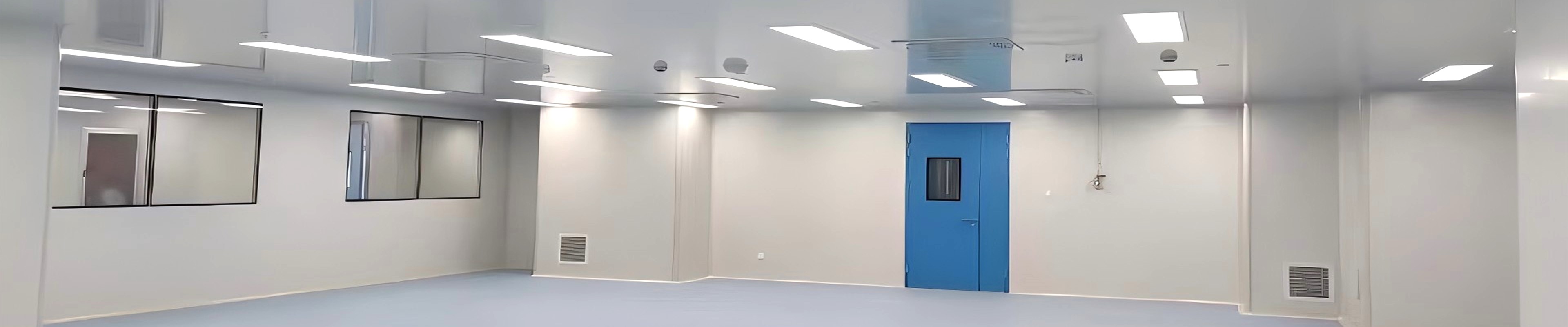
To ensure indoor air temperature, humidity, velocity, and cleanliness satisfy both process requirements and personnel comfort, a rational airflow organization must be designed so that air movement within the space conforms to cleanroom specifications.
Cleanroom airflow organization differs fundamentally from conventional air conditioning. The primary task of cleanroom airflow is to supply sufficient clean air to dilute and replace contaminants generated indoors, maintaining cleanliness within permissible limits. In contrast, general air-conditioned rooms typically employ highly turbulent airflow patterns, using minimal ventilation to maximize temperature and humidity uniformity. Supply air mixes thoroughly with room air to create uniform temperature and velocity fields. Consequently, cleanroom airflow design should adhere to the following essentials.
Design Essentials for Unidirectional Airflow
1. Prevent Filter Leakage
If filters leak, the principal advantage of unidirectional airflow is compromised. Therefore, leakage must be avoided.
2. Ensure Uniform Supply Airflow
Increase the filter coverage ratio to reduce the impact of frame blind zones.
3. Improve Supply Air Velocity Uniformity
Non-uniform supply velocity typically results from uneven pressure across filters and plenums, as well as excessive inlet velocity into the plenum. Key countermeasures include:
(1) Select high-efficiency filters rigorously. During installation, balance units according to individual resistance so that the deviation between any filter’s resistance and the group average is less than 5%.
(2) Install damping layers beneath filters—even non-uniform damping layers if necessary. Increase plenum height, preferably above 800 mm.
(3) Change from centralized duct supply into the plenum to distributed duct supply.
(4) If inlet velocity is too high or only single-side inlet is possible, install adjustable baffles on filters near the inlet. Alternatively, increase internal plenum resistance by placing a perforated plate near the outlet.
4. Improve Return Air Velocity Uniformity
The same measures applied to supply ducts can be used for return ducts: distributed ductwork, balancing dampers, damping fabric at return grilles, reducing return face velocity below 5 m/s, and adjusting floor opening ratios.
Design Essentials for Non-Unidirectional Airflow
1. Maintain Positive Pressure
(1) Pressurization Airflow Pressurization airflow is determined mainly by envelope leakage. Expressed as air changes per hour (ACH), reference values are shown below. For rough estimates, use 2–3 ACH.
|
Room Pressurization (Pa) |
Required ACH (Double Door) |
Required ACH (Single Door) |
|
9.8 (1.0 mmH₂O) |
4.0 |
2.6 |
|
14.7 (1.5 mmH₂O) |
5.1 |
3.3 |
|
19.6 (2.0 mmH₂O) |
6.0 |
4.0 |
|
29.4 (3.0 mmH₂O) |
7.5 |
4.9 |
|
44.1 (4.5 mmH₂O) |
9.5 |
6.2 |
(2) Pressurization Control Consider envelope structural strength and door opening convenience. Generally, control the pressure differential with adjacent rooms within the range of 5–20 Pa (0.5–2.0 mmH₂O).
2. Control Local Dust Generation
In non-unidirectional cleanrooms, turbulent airflow allows dust to diffuse anywhere. If dust generated locally affects the entire room uniformly, the result is highly undesirable; even a large increase in air changes produces limited improvement. The best approach is to address local airflow organization directly by enclosing local dust-generating equipment and providing local exhaust.
3. Fan Pressure Head Selection
The past practice of selecting fan pressure with excessive margin is inappropriate. Because filters operate below rated airflow in actual service, selecting a fan at twice the filter resistance creates excessive initial pressure margin, resulting in excessive airflow and velocity. Throttling dampers too far then generates significant noise. When system resistance can be calculated in detail, final resistance from coarse to high-efficiency filters may be taken as initial resistance plus 50–120 Pa. If system resistance is difficult to calculate or only a rough estimate is needed, the conventional method of twice the initial resistance may still be used.
4. Fan Selection
Select high-efficiency, low-noise fans. It is essential that the operating point lie on the steeper portion of the fan performance curve, and that the curve itself be steep rather than flat. This ensures that large pressure changes produce minimal airflow variation, avoiding significant operational impact.
Summary
In summary, airflow organization is a critical aspect of cleanroom design. Many applications require CFD simulation software for airflow analysis, leveraging visualization of simulation results to validate the design.
Post time: May-15-2026