
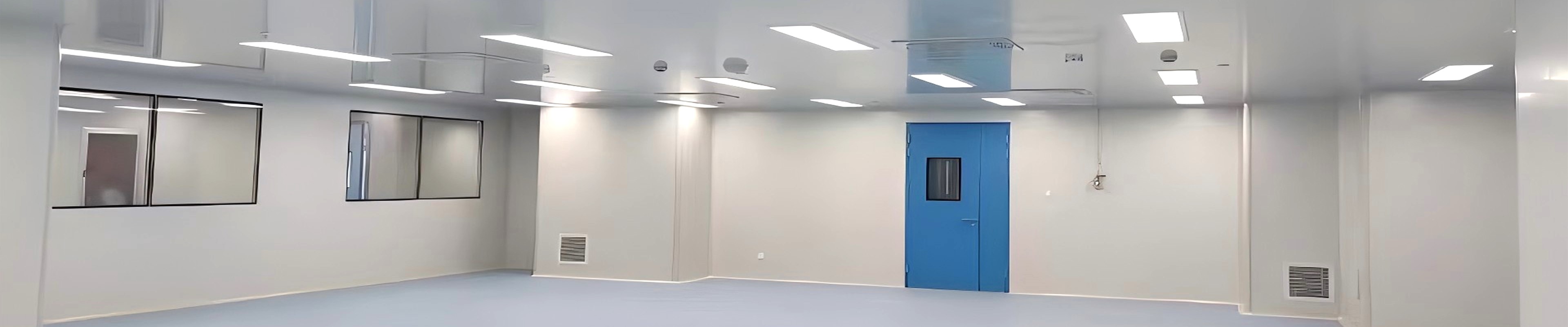
On paper, the choice between an H13 and an H14 cleanroom filter looks like a single digit — a difference of one nine in the efficiency rating. In practice, the decision runs through terminal penetration rate, initial pressure drop, fan energy consumption, filter service life, in-situ leak testing, and the contamination risk of the product being manufactured.
H14 is not required in every cleanroom, and H13 is not simply a "lower-specification" version of the same product. A defensible selection has to consider the cleanroom class, the process risk, the system airflow design, and the total lifecycle cost together. This article sets out the decision framework — including a worked cost calculation — so that filter selection is made on engineering grounds rather than on a unit price comparison or a marketing efficiency claim.
1. The Selection Principle at a Glance
| Scenario | Selection Guidance |
| General clean production, general assembly, some ISO 7–8 zones | H13 is usually sufficient, provided system validation demonstrates the target class is met |
| Aseptic filling, critical exposed operations, high-risk biological processes, zones requiring higher terminal integrity assurance | Evaluate H14 first, combined with per-unit scan leak testing and strict installation sealing |
| Semiconductor, optoelectronics, precision electronics | Do not decide on H13 vs H14 alone — ULPA, FFU airflow, airflow pattern, air change rate, and local contamination control must be assessed together |
| Where the project specification already defines the class | Meet the design specification and validation requirement first; purchase cost is a secondary consideration |
In one sentence: H13 addresses the economics of "achieving the target cleanliness," while H14 emphasises terminal filtration safety margin and risk control. Where the project documentation specifies a class, that requirement governs — "technically it would probably be sufficient" is not a substitute for a compliant specification.
2. What the Extra Nine Actually Changes
H13 and H14 are classified under the EN 1822 and ISO 29463 high-efficiency filter standard systems. The governing metric is not a promotional figure at one fixed particle size, but efficiency and leakage control measured at the Most Penetrating Particle Size (MPPS). The practical conversion is straightforward:
| Class | Typical Overall Efficiency at MPPS | Theoretical Penetration | Particles Penetrating per Million |
| H13 | ≥99.95% | ≤0.05% | ≤500 particles per million |
| H14 | ≥99.995% | ≤0.005% | ≤50 particles per million |
H14 therefore reduces theoretical penetration by roughly 90% relative to H13 — about a tenfold reduction in penetrating particles.
This factor of ten, however, describes only the theoretical difference in filter media performance under specified test conditions. It does not mean the finished cleanroom will be ten times cleaner, nor that field contamination risk automatically drops tenfold. The actual result is dominated by factors outside the filter element:
• Whether every filter is individually leak tested after installation, and whether any local bypass exists
• The reliability of the frame, knife-edge or spigot joint, filter clamp, and seal elements
• The actual airflow, face velocity, and uniformity delivered by the FFU or air handling unit
• The particle load generated by personnel, materials, equipment, and the process itself
• Whether the air change rate, pressure gradient, and recovery time meet the design specification
If installation sealing is compromised by bypass, the advantage of H14 media may be outweighed in practice by a well-sealed H13 system. Filter class and installation quality are separate variables, and the second one is frequently the more decisive.
3. Why Higher Efficiency Does Not Always Cost Less
To reach a lower penetration rate, H14 generally requires higher-performance filter media, tighter manufacturing control, and stricter leak test requirements. The same design also tends to affect airflow and pressure drop.
At the same dimensions, rated airflow, and comparable construction, the initial pressure drop of an H14 may be higher than that of an H13. The actual difference cannot be inferred from the class alone — it depends on filter area, pleat pitch, separation type (mini-pleat or pleated with separators), face velocity, and the supplier's specific design. Initial resistance figures published by suppliers should always be requested at the design airflow for the project.
When pressure drop rises, the fan must deliver a higher static pressure. In a variable air volume (VAV) system, the control loop may raise fan speed to maintain the required supply airflow. In a constant air volume (CAV) system, the delivered airflow may fall. Both outcomes carry a cost:
• Higher fan speed means higher electrical consumption and increased motor thermal loading
• Reduced airflow degrades cleanliness class, recovery time, and temperature and humidity control stability
• Higher pressure drop across the filter bank shortens the maintenance interval for both pre-filters and terminal filters
• A system running continuously at high fan speed to "hold the airflow" produces higher noise levels and accelerated equipment wear
The cost of H14 should therefore be evaluated across the full lifecycle: filter media purchase, fan energy over the operating life, replacement frequency, and the cost of validation and ongoing maintenance — not the unit price of the filter alone.
4. A Worked Cost Comparison
The following example demonstrates how the energy component is calculated. The figures are illustrative; for a real project, the supplier's initial resistance, terminal resistance, and resistance curve at the design airflow must be used.
Assumptions: 100 terminal filters of 484 × 484 mm; rated airflow 1,000 m³/h per filter; 6,000 operating hours per year; electricity at 0.80 CNY/kWh; combined fan and motor efficiency of 55%; average operating resistance difference between H13 and H14 of 40 Pa.
4.1 Fan Power Increase from Added Resistance
The additional power required by the fan to overcome an added pressure difference is:
Additional power (kW) = Airflow (m³/s) × Added pressure (Pa) ÷ 3600 ÷ Combined efficiency
The total airflow across 100 filters is 100,000 m³/h, which converts to approximately 27.8 m³/s. Substituting 40 Pa and a combined efficiency of 55%:
| Calculation Step | Value | Basis |
| Total airflow | 100,000 m³/h = 27.8 m³/s | 100 filters × 1,000 m³/h |
| Added pressure difference | 40 Pa | H14 vs H13 average operating resistance difference |
| Additional fan power | ≈ 2.0 kW | 27.8 × 40 ÷ 3600 ÷ 0.55 |
| Additional annual energy | ≈ 12,000 kWh | 2.0 kW × 6,000 h |
| Additional annual electricity cost | ≈ 9,600 CNY | 12,000 kWh × 0.80 CNY/kWh |
If the operating hours increase to 8,000, or if the fan efficiency is lower, or the resistance difference is larger, the energy cost difference grows accordingly. Conversely, if the H14 design controls resistance effectively through increased filter area, the actual energy difference may be materially smaller than this example suggests.
4.2 Capital Cost Comparison
Capital cost must be considered separately. Using an illustrative unit price difference of 100–200 CNY per filter, 100 filters represent an initial purchase difference of approximately 10,000–20,000 CNY. Adding per-unit scan leak testing, installation commissioning, and the additional validation records required for the higher class, the first-phase investment difference may be larger again.
4.3 Consolidated Cost Comparison
| Cost Item | H13 | H14 — Typical Change |
| Purchase price | Baseline | Generally higher; difference depends on construction and brand |
| Installation and leak testing | Leak testing required | Usually requires stricter per-unit documentation and review |
| Fan energy consumption | Baseline | May increase, governed by the resistance difference |
| Filter service life | Governed by operating conditions | Cannot be judged from class alone; pre-filter and dust holding capacity dominate |
| Contamination risk | Acceptable when the design is met | Greater safety margin, but cannot compensate for installation defects |
| Validation cost | Depends on industry requirement | Typically higher for high-risk processes |
This table illustrates the central point: H14 is not necessarily "much more expensive." Its value is expressed primarily in risk cost, not in a proportionate increase in filtration efficiency.
5. Where H13 Is the Better Choice
5.1 The Target Class Is Already Validated with H13
If the room cleanliness class, air change rate, supply air uniformity, and recovery time have been validated with H13 filters installed, and the process carries no exceptional aseptic or particulate risk, H13 is often the more economical selection. Upgrading to H14 in this situation adds cost without a corresponding improvement in the demonstrated outcome.
5.2 High Terminal Filter Counts, High Airflow, and Long Operating Hours
In facilities with hundreds or thousands of terminal filters running continuously, the resistance penalty is multiplied across the entire filter bank. The energy impact of a 40 Pa difference can become a material operating cost line. In this case, H13 and H14 should be compared together with filter area, face velocity, and the control strategy — not on efficiency class in isolation.
5.3 Well-Designed Pre-Filtration and Reliable System Sealing
Where the pre-filter stage is properly specified and the envelope and terminal installation quality are stable, an H13 system will typically meet the requirements of conventional clean production. Conversely, where pre-filtration is inadequate or personnel discipline is poor, upgrading to H14 is a way of using a more expensive filter to mask a system problem that will continue to cause deviations.
6. Where H14 Earns Its Cost
6.1 The Product or Process Is Highly Particle-Sensitive
For aseptic exposed operations, critical filling zones, certain high-risk biological processes, and precision manufacturing areas with demanding particle control requirements, the lower penetration rate and additional safety margin of H14 align with the risk control logic of the process.
6.2 The Cost of a Contamination Event Is Very High
If a single contamination event could lead to batch rejection, extended line shutdown, batch investigation, and revalidation, the filter price difference is usually a small fraction of the total risk exposure. The correct question is not "how much more does the filter cost" but "how much is it worth to prevent one event."
6.3 The Project Specification, Client Audit, or Validation Protocol Requires It
Pharmaceutical, medical device, sterile food, and high-end manufacturing projects commonly operate under company standards, client specifications, or validation protocols. Where those documents specify H14, substituting H13 is not recommended — even where measured performance may be close, the substitution can create problems during acceptance testing and regulatory audit.
7. Four Items Not to Miss When Upgrading H13 to H14
7.1 Confirm the Test Standard and the Measurement Basis
Require the supplier to provide the classification basis, test conditions, rated airflow, initial resistance, terminal resistance, and both local and overall efficiency. A certificate bearing only the marking "H14" is not sufficient evidence.
7.2 Confirm the Per-Unit Leak Testing Method
Media efficiency certification does not establish that the complete filter and its installation interface are leak-free. For high-risk zones, specify the factory leak test, the on-site scan test, and the acceptance criteria explicitly, and require records for every unit.
7.3 Re-verify the Fan Margin
After any upgrade to H14, the fan static pressure, variable frequency drive range, airflow balance, noise level, and motor power must be rechecked. Replacing H13 filters with H14 units and leaving the original fan selection unchanged risks operating the system outside its design envelope.
7.4 Check the Pre-Filtration and Sealing Arrangement
If the G4, F7, or other pre-filter stage is inadequate, H14 filters will load faster and the resistance penalty will compound. If the frame seal, clamp, or spigot arrangement is not reliable, the filtration advantage of H14 cannot be fully delivered to the cleanroom. A filter upgrade never substitutes for a system review.
8. A Decision Checklist for Procurement
The H13 or H14 decision can be reduced to five questions:
□ Does the design specification or client standard explicitly call for H14?
□ Is the loss from a single contamination event significantly greater than the filter price difference?
□ Does the system fan have sufficient static pressure margin to absorb the higher filter resistance?
□ Does the project have the capability to perform per-unit scan leak testing and produce complete validation records?
□ Are pre-filtration, envelope integrity, personnel flow, and airflow pattern already stable?
If the first two answers point toward high risk, and the remaining three can be satisfied, H14 is the more defensible selection. If the project is conventional clean production, the system is already validated, and the terminal filter count is high with long operating hours, the comparison should focus on H13's lower resistance, lower initial investment, and lower lifecycle energy consumption.
Conclusion
The meaningful comparison is not "one extra nine" but system risk. H14 delivers a theoretical penetration rate roughly one order of magnitude lower than H13 at the MPPS, but that advantage does not automatically translate into a proportionate improvement in overall cleanroom performance. Its additional value comes from a greater filtration margin, a lower terminal penetration risk, and stronger fit with audit and validation requirements.
When specifying filters, request efficiency, resistance, airflow, leak testing, sealing arrangement, and service life data from the supplier — then place purchase price, fan energy cost, validation cost, and contamination risk on a single comparison sheet. For conventional applications, H13 is often the more balanced choice. For high-risk processes, the price difference for H14 generally buys a measurable reduction in risk.
Frequently Asked Questions
Q1: What is the actual efficiency difference between an H13 and an H14 cleanroom filter?
Under the EN 1822 and ISO 29463 classification systems, H13 requires at least 99.95% efficiency at the Most Penetrating Particle Size, giving a theoretical penetration of 0.05% or about 500 particles per million. H14 requires at least 99.995%, giving 0.005% penetration or about 50 particles per million. H14 therefore reduces theoretical penetration by roughly 90% — a tenfold reduction — relative to H13 under specified test conditions.
────────────────────────────────────────────────────────────────────────────────
Q2: Does an H14 filter automatically make the cleanroom ten times cleaner than an H13 system?
No. The tenfold difference describes only the theoretical performance of the filter media under test conditions. Actual cleanroom results are dominated by installation quality, per-unit leak testing, fan airflow and face velocity, process particle load, air change rate, and pressure gradient. A well-sealed and correctly verified H13 installation may outperform a poorly installed H14 system in practice. Filter class and installation quality are independent variables.
────────────────────────────────────────────────────────────────────────────────
Q3: How much does the energy cost of H14 differ from H13?
It depends on the resistance difference, airflow, operating hours, and fan efficiency. In a worked example — 100 filters at 1,000 m³/h, 6,000 hours per year, 40 Pa average resistance difference, 55% combined fan and motor efficiency — the added fan power is approximately 2.0 kW, giving about 12,000 kWh and 9,600 CNY in additional annual electricity cost. A higher resistance difference or longer operating hours amplifies this. If the H14 design controls resistance through increased filter area, the actual difference may be considerably smaller.
────────────────────────────────────────────────────────────────────────────────
Q4: When is H13 the more economical and technically defensible choice?
H13 is generally the better selection when the target cleanliness class has already been validated with H13 filters in place, the process carries no exceptional aseptic or particulate risk, the terminal filter count is high with long continuous operating hours (making the resistance penalty significant), and pre-filtration and installation sealing are already reliable. In these cases, upgrading to H14 adds cost without a demonstrated improvement in the validated outcome.
────────────────────────────────────────────────────────────────────────────────
Q5: What should be checked before upgrading an existing installation from H13 to H14?
Four items: (1) confirm the classification basis and measurement data — efficiency at MPPS, rated airflow, initial and terminal resistance, and local and overall efficiency, not just a certificate marked H14; (2) confirm the per-unit leak testing protocol including factory test, on-site scan test, and acceptance criteria; (3) re-verify fan static pressure margin, VFD range, airflow balance, noise, and motor power, because the original fan selection may no longer be adequate; (4) verify the pre-filtration stage and the frame, clamp, and seal arrangement, since an upgrade cannot compensate for inadequate pre-filtration or unreliable sealing.
Post time: Oct-30-2026