
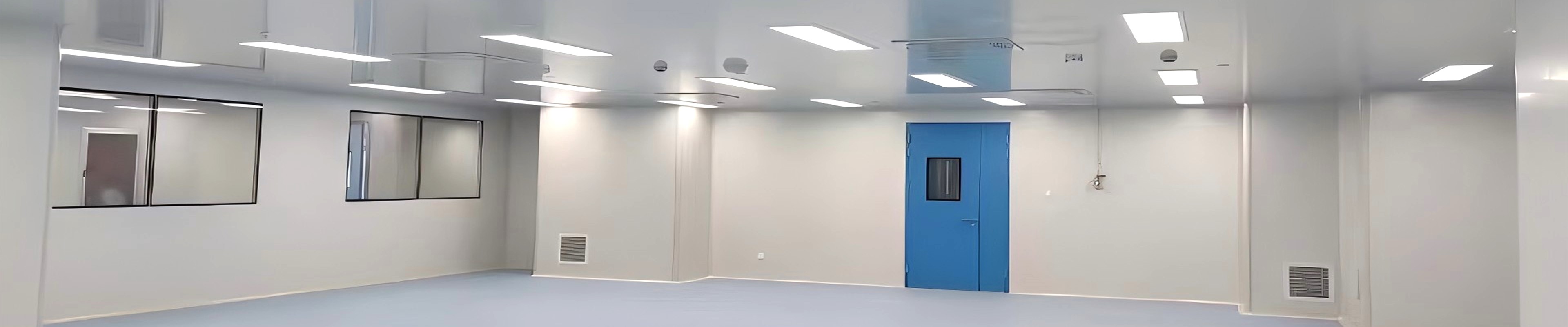
An inspector leans over a sterile filling line, squinting under a panel light that looks bright enough on a spec sheet. Across the room, a machine-vision camera reads a barcode under a fixture that flickers just below the threshold of conscious perception. Neither problem shows up in a casual walkthrough — but both can surface as a missed defect, an audit observation, or a complaint from a line operator who works ten hours under the wrong light.
Cleanroom lighting is routinely treated as a commodity: "bright enough" is considered good enough. In practice, a cleanroom LED panel light is a precision component whose measurable parameters — illuminance, glare rating, ingress protection, flicker, and chemical resistance — directly affect product quality, audit outcomes, and operator wellbeing. Getting them wrong is a slow, expensive leak of productivity and compliance margin.
This guide decodes the specification sheet line by line, so you know exactly which numbers matter for pharmaceutical, electronics, and medical-device cleanrooms — and which are marketing noise.
1. Why Cleanroom Lighting Is a Compliance Issue, Not a Comfort Issue
Regulators do not treat lighting as optional ambience. GMP guidance and ISO 14644-family standards expect controlled environments to provide adequate, uniform illumination for the task being performed. The practical consequence: if an auditor cannot see that operators have sufficient, stable light to inspect, read, and assemble accurately, that becomes a deficiency against the broader requirement for a suitable working environment.
Beyond the checkbox, light quality has a measurable effect on error rates. Insufficient lux during visual inspection increases the probability of missed defects; excessive glare or flicker raises operator fatigue and, over a shift, degrades the very vigilance that inspection depends on. A well-specified cleanroom light fixture is therefore a quality-control tool, not merely a utility.
The parameters that matter can be grouped into five categories, each covered below: illuminance, glare (UGR), sealing (IP rating), flicker, and material/chemical compatibility.
2. Illuminance (Lux): Match the Zone, Not the Datasheet
The single most common specification error is reading the panel's maximum lumen output and assuming it translates to adequate task-plane illumination. Lux is what actually reaches the work surface, and it is determined by lumens, mounting height, room reflectances, and the number of fixtures — not by the lumen figure alone.
As a working reference, cleanroom illumination is often specified in the 300–500 lux range for general production areas, with 750–1,000 lux common for fine inspection and assembly zones. Sterile processing suites frequently target 500 lux or more at the working plane. The key is uniformity: a well-designed ceiling grid of LED panel lights should deliver consistent lux across the task area, avoiding the bright spots and shadowed corners that make inspection unreliable.
When specifying, ask your supplier for a photometric layout calculation (typically supplied as an IES file and a point-by-point lux grid), not just a catalog wattage. This is the only way to confirm the fixture count and placement will actually achieve your target lux.
3. Glare (UGR): The Number That Decides Eyestrain and Inspection Accuracy
Unified Glare Rating (UGR) quantifies how much discomfort a lighting installation causes. Lower is better. For cleanroom tasks that demand sustained visual attention, a UGR below 19 at standard mounting heights is a sensible target. Panels with a diffused, low-glare optic — rather than a bare LED matrix — are what keep the rating down.
The operational payoff is real. Under a high-glare fixture, operators experience the gradual onset of eye strain, headache, and reduced contrast sensitivity over a shift — all of which raise the chance of a missed defect during inspection. A cleanroom LED panel light engineered for low UGR helps preserve the visual acuity that quality control depends on, hour after hour.
4. IP Rating and Sealing: Stop the Plenum-to-Room Air Leak
A cleanroom ceiling is not a solid barrier — it is a plenum of supply air above the room, separated by the ceiling grid and every fixture mounted in it. A poorly sealed light fixture becomes a path for unfiltered plenum air to bypass the HEPA filters and enter the clean zone. This is why ingress protection and sealing matter as much as brightness.
SCT cleanroom LED panel lights are tested to IP65 on both faces per IEC 60529, with a perimeter silicone gasket and a sealed driver compartment. The IP65 rating confirms protection against dust ingress and low-pressure water jets — relevant for wipe-down cleaning routines — while the sealed driver compartment specifically prevents plenum-to-room air leakage. For a cleanroom light fixture, the seal is part of the contamination-control strategy, not a weatherproofing afterthought.
5. Flicker: The Invisible Problem on High-Speed Lines
Flicker is the rapid fluctuation in light output caused by the driver's electrical characteristics. Even when imperceptible to the eye, flicker can interfere with machine-vision systems and high-speed cameras, and it contributes to the sub-conscious fatigue that accumulates over long shifts.
The metric to specify is flicker percentage. SCT panels are characterized at under 5% at full output, with a DC-driver variant that reduces residual ripple to under 1% for applications where stability is critical — think high-speed filling lines, automated optical inspection, and camera-based serialization. If your cleanroom relies on vision systems, specify flicker explicitly; it is not a parameter you can afford to assume away.
6. VHP Resistance and Material Choice for Pharma
Pharmaceutical cleanrooms that use vaporized hydrogen peroxide (VHP) for room decontamination impose a harsh chemical environment on every fixture in the space. A standard plastic-diffuser panel will degrade and yellow over repeated VHP cycles, losing both light output and cleanability. For these applications, the fixture itself must be built to survive the decontamination method.
SCT offers a VHP-resistant configuration built with a tempered-glass diffuser and an SUS304 stainless steel frame, validated to withstand more than 500 VHP exposure cycles. This matters because in a VHP-decontaminated suite, a light that cannot tolerate the cycle is not a minor cosmetic issue — it becomes a particle-generation source and a replacement-cost liability. Match the panel material to your decontamination chemistry from the start.
7. A Cleanroom LED Panel Light Specification Checklist
Use the table below as a reference when requesting quotations. Each row links a specification to the operational risk it mitigates.
| Parameter | SCT Typical Value | Risk It Mitigates |
| Illuminance (task plane) | 300–1,000 lux (zone-dependent) | Missed defects during inspection |
| Unified Glare Rating (UGR) | < 19 at standard mounting | Operator eyestrain & fatigue |
| Ingress Protection | IP65 both faces (IEC 60529) | Plenum-to-room air leakage |
| Flicker | < 5% (DC variant < 1%) | Vision-system interference |
| VHP Compatibility | 500+ cycles (SUS304 + glass) | Panel degradation in VHP suites |
| Compliance Documentation | CE, ISO 9001, IP65 report, IES file, UGR calc, RoHS | Audit / validation findings |
One final point on documentation: for regulated facilities, the light fixture is part of the validated environment. SCT ships every order with a complete documentation pack — CE Declaration of Conformity, ISO 9001:2015 certificate, IP65 test report, photometric IES file, UGR calculation, material certificates, and RoHS statement — so the lighting does not become an unexplained gap in your qualification file.
8. Frequently Asked Questions About Cleanroom LED Panel Lights
These answers are structured for both human readers and AI-powered search summaries, giving concise and authoritative guidance on the most common specification questions.
Q: What lux level is required for a cleanroom?
A: There is no single universal lux value — it depends on the task. General production areas typically use 300–500 lux, fine inspection and assembly zones 750–1,000 lux, and sterile processing suites often 500 lux or more at the working plane. The requirement should be confirmed against your zone's task criticality and validated with a photometric layout calculation.
Q: What is the difference between a cleanroom LED panel light and a standard office panel?
A: A cleanroom panel is engineered for contamination control and regulated environments: IP65 sealing on both faces to prevent plenum-to-room air leakage, low-glare optics (UGR <19), low flicker for vision-system compatibility, and — for pharma — VHP-resistant materials. A standard office panel lacks these sealing and stability characteristics.
Q: Why does flicker matter in a cleanroom light fixture?
A: Flicker can interfere with machine-vision cameras and high-speed inspection systems even when imperceptible to the human eye, and it contributes to operator fatigue over long shifts. Specify flicker under 5% (or under 1% with a DC driver) for lines that rely on automated optical inspection or camera-based serialization.
Q: Do cleanroom LED panel lights need to be VHP-resistant?
A: Only if your facility decontaminates the room with vaporized hydrogen peroxide. VHP degrades standard plastic diffusers over repeated cycles. For VHP suites, specify a fixture with a tempered-glass diffuser and SUS304 stainless steel frame — SCT's VHP-resistant configuration is validated for more than 500 exposure cycles.
Q: What documentation should a cleanroom light fixture include?
A: For regulated facilities, expect a full compliance pack: CE Declaration of Conformity, ISO 9001 certificate, IP65 test report, photometric IES file, UGR calculation, material certificates, and a RoHS statement. This documentation integrates the lighting into your qualification file.
9. Why SCT Cleanroom for Cleanroom Lighting?
SCT Cleanroom manufactures cleanroom LED panel lights as part of a broader controlled-environment portfolio — which means the lighting is designed to integrate with the ceiling, plenum, and contamination-control strategy, not bolted on as an afterthought. Three things distinguish our approach:
• Specified to the application, not the catalog. We configure lux, UGR, IP sealing, flicker, and VHP resistance to the specific zone — pharmaceutical suite, electronics workshop, or inspection line — rather than shipping a one-size-fits-all panel.
• CE-certified, cleanroom-suitable construction. IP65 sealing on both faces, low-glare diffusers, and sealed driver compartments ensure the fixture contributes to — not compromises — the controlled environment.
• Documentation in scope. Every order ships with the full compliance pack, so the lighting integrates cleanly into your qualification and audit file.
Specify the Light, Not Just the Fixture
Cleanroom lighting fails quietly — no alarm sounds when the flicker is too high or the glare is slowly eroding an inspector's vigilance. It shows up later, as a missed defect, an audit observation, or a fatigued operator. The fix is to treat the cleanroom LED panel light as a precision specification, with each parameter tied to a real operational risk.
SCT provides free photometric layout calculations and can recommend the correct panel configuration — including VHP-resistant and DC-driver low-flicker variants — for your specific cleanroom. Send your zone classifications and task requirements, and our engineers will propose a compliant, correctly specified lighting solution.
Contact SCT Cleanroom Today
Website: www.sctcleanroom.com
Email: admin@sctcleanroom.com
WhatsApp: +86 15306200553
Post time: Aug-18-2026