
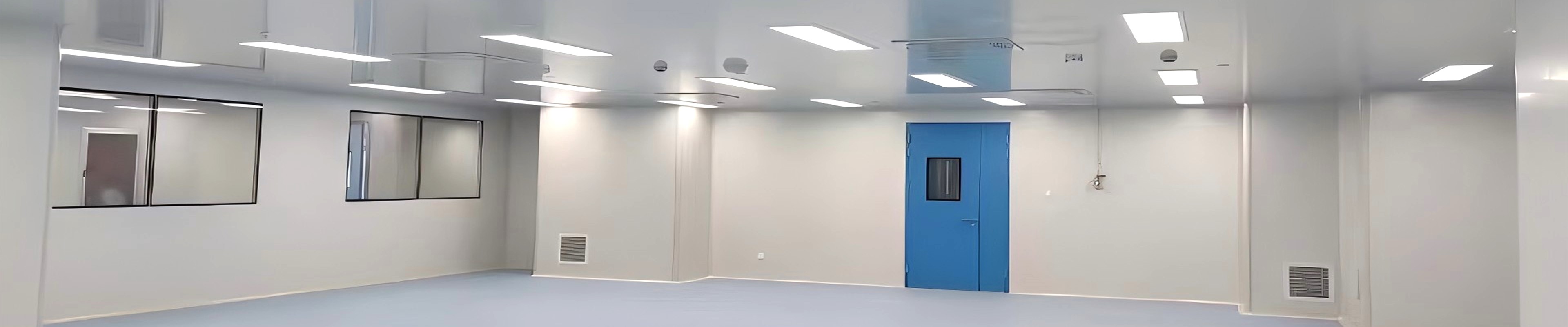
A cleanroom envelope is only as dependable as the panels that form it. Walls that bow under differential pressure, cores that delaminate after a few VHP cycles, or skin seams that open up between cleaning rounds are all failures that begin long before installation — they begin on the production line. The panel a project receives is the accumulated result of every material choice and quality check made upstream, inside the factory.
SCT's clean room panel production line exists to control that process end to end. Because the panels, windows, doors and ceiling systems are manufactured by a single source factory, the quality of the envelope is controlled at the point of origin — not negotiated between separate suppliers at the project site. This article walks through what happens on that production line, and why it matters more than the datasheet numbers alone.
1. Why the Production Line Decides More Than the Datasheet
Two cleanroom panels can carry identical specifications — same thickness, same core, same fire class — and perform very differently over a ten-year operating life. The difference is process. Panel performance is dominated by variables that no finished-product datasheet fully captures: how evenly the adhesive was applied, whether the core was conditioned before lamination, how flat the skins were rolled, and whether the edges were cut and sealed under control.
These are manufacturing variables, and they are only controlled by a production line designed around them. When a project buys panels from a trading company or an assembler that sources from multiple sub-factories, that process control is invisible — and unrecoverable — once the panels arrive on site.
2. Raw Material Control: Coil, Core, and Adhesive
The first quality gate is not on the line itself; it is at the raw material receiving bay. A cleanroom sandwich panel is built from three primary inputs, and each must be controlled before it enters production.
• Metal skin (coil). The outer skins are typically pre-coated galvanised steel, stainless steel, or aluminium. Surface finish, coating thickness, and flatness are verified against specification before slitting. A skin with a defective coating will not fail immediately — it will corrode, yellow, or lose cleanability over time.
• Insulating core. Core materials — rock wool, PU/PIR polyurethane foam, honeycomb, or EPS — are checked for density, dimensional tolerance, and (for fire-rated panels) the fire classification certificates required for the project. Rock wool gives A1/A2-s1,d0 non-combustibility for pharmaceutical applications; PU/PIR offers thermal performance at lower cost for less demanding grades.
• Adhesive / bonding system. The adhesive or injected-foam bonding system is the interface that holds skin to core. Its mixing ratio, temperature, and application uniformity determine bond strength and long-term delamination resistance — the single most common field failure in cheap sandwich panels.
3. Step by Step: How a Sandwich Panel Is Built
The production sequence that follows is what separates a controlled factory line from informal assembly. Each step carries a specific quality consequence.
1. Slitting and roll-forming. Coil is slit to width and passed through roll-forming stands that shape the metal into the panel skin profile, including the tongue-and-groove or interlocking joint that will seal one panel to the next on site.
2. Core cutting and conditioning. The core material is cut to panel dimensions. For rock wool, the blocks are cut to precise thickness and width; for PU/PIR, the foam is either injected or pre-formed. Core moisture and temperature are conditioned to ensure the adhesive bonds correctly.
3. Adhesive application and lamination. The two metal skins and the core are brought together under controlled adhesive application. In a continuous lamination line, pressure and temperature are held within tight windows so the bond forms uniformly across the full panel area — not just at the edges.
4. Pressing and curing. The assembled panel passes through a press or curing stage that sets the adhesive to its full bond strength. Insufficient curing time or uneven pressure shows up later as edge delamination or a soft, wavy surface.
5. Cutting, edge trimming, and joint machining. The cured panel is cut to final dimensions and the edge profiles are machined. This is where the interlocking joint geometry is formed — the feature that determines how cleanly panels fit together and how well they seal on site.
6. Edge sealing and finishing. Exposed core edges are sealed to prevent moisture ingress and particle shedding. In cleanroom applications, edge sealing is not cosmetic: an unsealed rock wool edge releases fibres and holds moisture, both of which undermine cleanroom classification.
4. Quality Checkpoints on the Line
Quality is checked at defined stations rather than once at the end. The checkpoints below are the ones that most directly map to envelope performance in service.
| Checkpoint | What Is Verified | Why It Matters in the Cleanroom |
| Dimensional tolerance | Length, width, thickness within specification | Clean joint fit; no on-site rework |
| Flatness / bow | Surface flatness across panel length | Prevents wavy walls and seal gaps |
| Bond strength | Adhesion test between skin and core | Prevents delamination over VHP cycles |
| Surface finish | Coating continuity; no scratches or pinholes | Cleanability and corrosion life |
| Fire classification | Batch verification against EN 13501 | Meets pharmaceutical fire-code requirements |
| Edge sealing integrity | Sealed, fibre-tight core edges | Stops particle shedding and moisture |
5. Panel Types and How Their Production Differs
Not all cleanroom panels are produced the same way. The table below summarises the main panel types and the production characteristics that distinguish them.
| Panel Type | Production Characteristic | Typical Application |
| Rock wool sandwich | A1/A2 fire class; strong acoustic damping | Pharmaceutical GMP, hospitals |
| PU / PIR foam | High thermal insulation; lighter weight; lower cost | Electronics, general cleanrooms |
| Honeycomb core | High flatness-to-weight ratio; thin profile | Ceiling panels, light partitions |
| EPS (polystyrene) | Economical; lower fire performance | Non-critical, budget projects |
6. How Factory QC Reduces On-Site Risk
The reason a source-factory production line matters to a project manager is concrete: it moves the failure modes from the site — where they are expensive and disruptive — back to the factory, where they are caught and corrected before shipment.
• Dimensional drift is caught before it becomes rework. A panel that is a few millimetres out of tolerance is a minor factory reject. The same panel on site becomes field cutting, resealing, and a compromised joint — or a wall that will not close to the door frame. Factory QC eliminates that translation cost.
• Flatness is verified, not hoped for. Wavy or bowed panels read as unprofessional and, more seriously, create seal gaps at panel joints and around windows and doors. A flatness check on the line is the only place flatness can be guaranteed at scale.
• Fire and material certificates are attached to the batch. When panels come from a single controlled factory, the material certificates, fire test reports, and surface-finish data are traceable to a specific batch. That traceability is exactly what GMP and ISO 14644 qualification files ask for.
7. Frequently Asked Questions About Clean Room Panel Production
Q: What is a clean room sandwich panel?
A: A clean room sandwich panel is a composite wall or ceiling panel made of two metal skins bonded to an insulating core — typically rock wool, PU/PIR foam, honeycomb, or EPS. The skins provide a cleanable, corrosion-resistant surface, while the core provides rigidity, insulation, and fire performance. Panels interlock along their edges to form a sealed cleanroom envelope.
Q: What core material is best for a pharmaceutical cleanroom panel?
A: Rock wool is the standard for pharmaceutical GMP cleanrooms because of its A1/A2-s1,d0 non-combustible fire classification and good acoustic damping. PU/PIR foam offers better thermal insulation and lower weight at a lower cost, and is commonly used in electronics and general cleanrooms where fire classification requirements are less strict.
Q: Why does panel production quality matter if the datasheet is the same?
A: Two panels can share the same thickness, core and fire class but differ in bond strength, flatness, dimensional accuracy and edge sealing — all of which are determined by production process, not the finished-product datasheet. Poor process control shows up later as delamination under VHP cycles, wavy walls, seal gaps, or fibre shedding from unsealed core edges.
Q: What quality checks should a clean room panel factory perform?
A: At minimum: dimensional tolerance, surface flatness/bow, skin-to-core bond strength, surface finish continuity, batch fire classification against EN 13501, and edge sealing integrity. These checks map directly to the failure modes that matter in a cleanroom — joint fit, seal integrity, cleanability, and non-combustibility.
Q: How does a source factory reduce on-site installation risk?
A: A source factory catches dimensional drift, flatness defects and missing certificates before shipment, where they are cheap to correct. On site, the same issues become field cutting, resealing, and compromised panel-to-door or panel-to-window joints. Single-source traceability also provides the batch-linked material and fire certificates that GMP and ISO 14644 qualification requires.
8. Why a Source-Factory Production Line Matters to SCT Customers
• The envelope is produced as one system. SCT manufactures the panels, windows, doors and ceiling components on coordinated lines, so the panel thickness, joint geometry and surface finish are matched from the start — not reconciled between three different suppliers on site.
• Batch traceability built into the process. Every panel batch carries the material, fire and finish certificates that a GMP or ISO 14644 qualification file requires. Traceability is a factory output, not a paperwork exercise performed after the fact.
• In-house QC at the point of origin. Because the production line is owned by SCT, quality checks are performed at the factory where defects are corrected cheaply — before a panel ever reaches the project site or the installation team.
Control the Envelope at Its Source
A dependable cleanroom envelope is not a matter of choosing panels with the right numbers on a datasheet. It is a matter of choosing a manufacturing process that controls those numbers — flatness, bond strength, dimensional accuracy, fire class, edge sealing — before the panels are loaded onto a truck. That is the capability a source-factory production line provides.
SCT supplies modular wall and ceiling panels produced on controlled in-house lines, with full batch traceability and the documentation cleanroom projects require. Contact SCT to discuss panel specifications, core materials and quantities for your next cleanroom build.
Post time: Sep-16-2026