
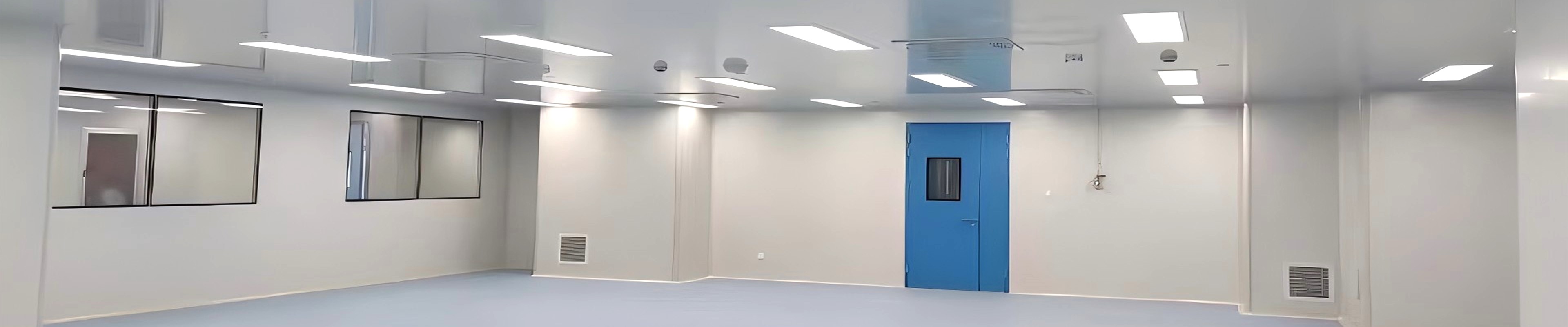
Anyone who has worked on cleanroom construction has seen this scene. The cleanroom panels are up, the ductwork is connected, the light fixtures are in, and the air-handling system is being commissioned. The whole project looks nearly finished. Yet one thing is conspicuously absent: the HEPA filters.
First-time participants almost always ask the same question: "Why not install them earlier?" Some say it is because HEPA filters are expensive, and people worry about damage during construction. Others say it is because leaving them out makes on-site work easier. Both explanations carry some truth — but neither is the real reason.
HEPA filters are installed last not for construction convenience, but to protect their ability to do their job. And to understand that, you have to start with a layer of dust on the construction site.
1. The Layer of Dust on the Construction Site
Many people assume that once construction ends, you simply clean the site and install the filters — isn't that just one extra step? In reality, for a HEPA filter, the dust generated during construction is not something a quick sweep can solve.
The main sources of construction dust are straightforward:
• Cutting cleanroom panels produces fine particulate
• Ductwork installation leaves metal shavings and debris
• Floor work, equipment installation, and constant personnel traffic continuously kick up fine particles
Most of these particles are visible to the naked eye. The real problem is the near-invisible fine particles. They travel with the airflow and are carried directly into the filter — and the HEPA filter's job is precisely to capture these particles.
Here is the problem: if a large volume of construction dust is already captured on the filter during construction, then by the time the project goes into operation, the filter has already been "working" for a long time. It can still be used, but its performance has already started to decline.
It is like a brand-new car air filter that, before ever hitting the road, is driven through a sandstorm for thousands of kilometers. It can still filter air — it is just no longer in its best condition.
2. The True Value of a HEPA Filter
Some people ask: the filter's whole job is to remove dust, so what is the harm in filtering a little early? This is a common and understandable misconception.
The value of a HEPA filter is not simply removing dust. It needs to maintain the design requirement stably, and for a long time, after the cleanroom officially goes into operation. The dust produced during construction is not only far greater in quantity than what the filter sees in normal operation — its particle composition is also complex, and many of those particles increase filter resistance and shorten service life.
In other words: a HEPA filter is not unable to filter construction dust. It simply should not spend its finite service life during the construction phase.
3. System Purge: Cleaning the Air First
This is why, during cleanroom construction, you will often see a particular practice: the air-handling system is already running, but the HEPA filters are not yet installed. In their place are pre-filters, medium-efficiency filters, or temporary protective measures. The purpose is singular — let the system "blow the construction environment clean" first.
Industry term — system purge (also called air purge or blow-down): the process of running the air-handling system without final HEPA filters so that airborne construction dust is gradually flushed out of the environment before the final filters are installed.
After running continuously for a period, the airborne construction dust gradually decreases and the indoor environment reaches installation conditions. Only then do the HEPA filters formally enter the site. Many people see this as just a construction step. In reality, it is more like protection — protecting not only the filter, but the entire cleanroom system.
4. Installation Complete Does Not Mean Work Done
Installing the HEPA filter does not mean the work is over. On the contrary, its real job is only just beginning. After installation, you still need to verify that the mounting is secure, the seal is reliable, and then perform a leak test to confirm there are no leak points.
Because for a cleanroom, a HEPA filter that is not installed properly — even one with high filtration efficiency — can lose its effectiveness entirely due to a poor seal. Many cleanroom projects carry out cleanliness testing before handover, precisely to confirm that the whole system has reached the design requirement, not merely that the equipment has been bolted in place.
So installing HEPA filters last is not a construction habit. It is a critical link in cleanroom quality control.
5. The Engineering Logic Behind Every Step
Spend enough time in cleanroom construction and you will notice something interesting: many processes look like mere "experience," but behind them sits clear engineering logic.
✓ Installing HEPA filters last is one such case.
✓ Progressive commissioning of the cleanroom is another.
✓ Differential-pressure testing, air balance, and cleanliness testing — all of them follow the same principle.
These steps do not exist to add work. They exist to ensure that the final deliverable is not just a finished room, but a controlled environment that genuinely meets the design requirement.
CORE TAKEAWAY
Understand this, and you have learned more than a construction sequence — you have begun to understand a way of thinking in cleanroom engineering. In cleanroom engineering, every construction step ultimately serves contamination control. And that is the common logic behind many of the details that otherwise look like arbitrary rules.
Frequently Asked Questions About HEPA Filter Installation
Q: Why are HEPA filters installed last in cleanroom construction?
A: HEPA filters are installed last to protect their service life. During construction, large volumes of dust are generated by panel cutting, ductwork, and personnel traffic. Installing the filters only after a system purge blows the environment clean ensures the filters start their working life in a clean room, not a construction zone.
Q: What is system purge (blow-down) in cleanroom construction?
A: System purge is the practice of running the air-handling system without the final HEPA filters, using pre-filters, medium-efficiency filters, or temporary protection instead. This flushes airborne construction dust out of the environment before the final filters are installed, protecting them from premature loading.
Q: Can a HEPA filter remove construction dust?
A: Yes, a HEPA filter can physically capture construction dust — but it should not have to. Construction dust is far greater in quantity and more complex in composition than normal operating particulate, and it accelerates filter loading, raises resistance, and shortens service life. The filter's finite life should be reserved for clean operation, not construction.
Q: What should be done after installing a HEPA filter?
A: After installation, verify that the mounting is secure and the seal is reliable, then perform a leak (integrity) test to confirm there are no leak points. A poorly sealed HEPA filter can fail regardless of its filtration efficiency. Cleanliness testing before handover confirms the whole system meets design requirements.
Q: How does construction dust affect HEPA filter service life?
A: Construction dust increases filter resistance faster than normal operational particulate, causing the filter to reach its final resistance (roughly 2× initial resistance) sooner. In effect, the filter "pre-works" during construction, so its usable life in the operating cleanroom is reduced.
Knowledge Index — CEKB-015
This entry belongs to the SCT Cleanroom Engineering Knowledge Base (CEKB). CEKB-015 covers the High-Efficiency Air Filter (HEPA) — the core final-stage air filtration device in a cleanroom. Its installation timing, sealing quality, leak-test verification, and operational maintenance all directly affect the cleanroom's final operating performance.
Upcoming CEKB entries will continue with HEPA filter selection, installation practice, leak testing, and replacement cycles. For related cleanroom equipment that depends on HEPA filtration — including air showers and pass boxes — see the related resources below.
Related SCT Resources
• Cleanroom air shower (HEPA-filtered personnel entry) — https://www.sctcleanroom.com/air-shower-for-cleanroom/
• Cleanroom pass box (HEPA-filtered material transfer) — https://www.sctcleanroom.com/cleanroom-pass-box/
• 100K clean room construction — https://www.sctcleanroom.com/100k-clean-room/
Contact SCT Cleanroom
Website: www.sctcleanroom.com
Email: admin@sctcleanroom.com
WhatsApp: +86 15306200553
Post time: Sep-02-2026